How Are Lost Wages Calculated in a California Personal Injury Claim?
Every day you can't return to work after an accident brings direct financial loss. Yet most victims only remember to account for their base salary. Elements like overtime, commissions, bonuses, accrued leave, or reduced future earning capacity are often left out of the calculation, even though California law says these are compensable too.

Lost income isn't a single calculation. Under California Civil Jury Instruction, it's divided into five distinct categories, each requiring different evidence and calculation methods. So in today's article we'll cover:
In this article:
- What compensation can be claimed for lost wages?
- What's the difference between lost wages and lost earning capacity?
- How does the calculation change by profession?
- What happens to compensation if you're partly at fault?
- What documents are needed to prove a claim?
- Why shouldn't you accept the insurance company's first offer?
If you or someone close to you has filed a personal injury claim in California and have doubts about lost wages, we hope today's article will be extremely helpful for you.
What compensation can be claimed for lost wages?
In a California personal injury claim, lost wages don't just cover your base salary. You can claim all types of financial benefits directly or indirectly damaged because of the accident. According to California Civil Jury Instruction, a victim can claim the following financial losses as compensation:
1. Past Lost Wages
Past lost wages are the money you actually lost in hand because your injury from the accident kept you from going to work. In simpler terms, from the day of the accident until today, however much less you earned from your job or work, that's your past lost wages.
Suppose you earn $20 an hour, working 8 hours a day. That means your daily income is $160. Due to a car accident, the doctor tells you to rest completely for 10 days, and you can't go to work for those 10 days.
10 days × $160 = $1,600 in past lost wages.
What else gets added to this?
Not just your base salary, everything else you lost by not going to work falls under this too:
- Overtime: If you regularly worked 5 hours of overtime per week, the overtime pay you would have earned during those 10 days gets added too.
- Tips or commission: If your job regularly involves tips or sales commission, the average daily tips/commission is calculated and added.
- Lost leave: You might think, "I didn't go to work, but I used the company's sick leave or accrued vacation, so my pay wasn't cut." California law says that because of the accident, your valuable leave days were wasted, so you get compensated for those leave days as well.
In short, because of someone else's mistake, the money that should have come into your pocket in the past but didn't, that is your past lost wages.
Since this is a past event, specific evidence or documents are required. To show this to the insurance company or the court, you generally need 3 things:
- Pay Stubs: Pay stubs from the 3 to 6 months before the accident.
- Wage Verification Letter: Written proof from your company of how many days you were absent and what your pay rate was.
- Medical Authorization: A doctor's written instructions proving that the injury physically or mentally prevented you from being able to go to work.
2. Lost Benefits/Leave Time
You got injured because of someone else's mistake, yet you had to use your own hard-earned sick leave to recover. Under California law, this lost leave time can also be recovered from the insurance company or the at-fault person.
Many think, "I was on leave and the company paid me for those days, so I didn't suffer any financial loss." But the law treats this as a loss too, because if you hadn't had the accident, that leave would still be banked in your account.
You need to get a letter or document from your company's HR or payroll department. It should clearly state:
- How many days you were absent because of the accident.
- How many hours or days of sick leave, vacation, or PTO (Paid Time Off) were used during your absence.
- What your hourly or daily earning rate is.
3. Lost Earning Capacity
If the injury leaves you permanently partially or fully disabled, or unable to do the kind of higher-earning work you did before, this compensation applies.
- Future potential earnings: Based on your age, profession, and experience, the total amount you could have earned up until retirement is calculated at its present value and claimed.
- Lost promotions or career opportunities: If you were about to get a promotion or attend an interview for a higher-paying job and the accident happened, causing you to lose that opportunity, that potential income loss can be claimed too.
4. Self-Employment & Business Losses
If instead of working a regular job under a company you run your own business, freelance, or work as an independent contractor, and the accident prevents you from working, causing you to lose business income or profit, that's called self-employment or business loss.
Under California personal injury law CACI No. 3903C, a self-employed person has the same right as an employee to be compensated for lost income. However, unlike regular employees, they don't have a specific pay stub or HR letter, so proving this loss is a bit more complex. Business losses generally include two main things:
a. Lost Profits
Because of the accident, you couldn't work or were forced to keep your shop/office closed, and the profit your business was deprived of during that time is your lost business profit.
Suppose you're a real estate agent or freelancer. Because of the accident, you couldn't contact clients for 3 months. The average profit you would have made in those 3 months is your lost profit. Under California Civil Jury Instruction CACI No. 3903C and CACI No. 3903D, a victim has the legal right to full compensation for both their actual lost past income and their reduced future earning capacity.
b. Lost Business Opportunities
If, because you were injured, you were forced to cancel a specific client's work or a large project offer, then the guaranteed income that would have come from that project is your lost opportunity damage.
Suppose you're a graphic designer. The day right before the accident, you signed a $5,000 logo design contract with a company. But because of the accident, you couldn't do the work, and the company hired someone else. That $5,000 is a direct business loss to you.
To convince the insurance company of your loss, the following documents are typically used:
- Tax Returns: Usually Schedule C (Form 1040) from the last 1 to 3 years, showing your business's net profit.
- 1099 Forms: Proof of income received from clients in the years before the accident.
- Bank statements and invoices: Business bank statements from the months before the accident and invoices sent to clients, proving the continuity of your income.
- Communication records: In the case of a lost project, email or message exchanges with the client that clearly mention the project's budget and its cancellation due to your illness/injury.
5. Other Non-Financial or Fringe Benefits
Financial benefits received from the company beyond salary can also be claimed:
- Pension or 401(k) contributions: The retirement fund contributions the company stopped making during your days of absence.
- Health insurance premium: If, because your job was temporarily gone or you were on leave, you had to pay for health insurance out of your own pocket.
Lost Wages vs. Lost Earning Capacity: What's the Difference?
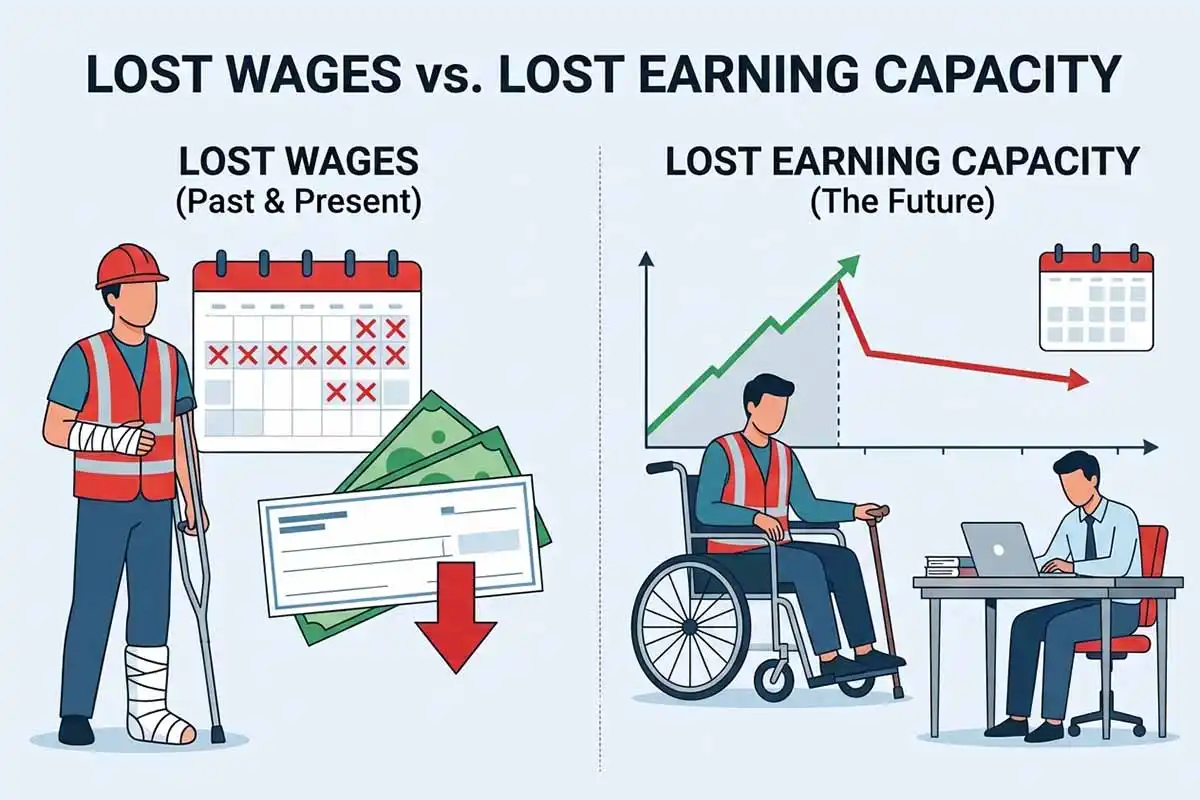
Under California personal injury law, there's a clear and very important difference between lost wages and lost earning capacity. According to California Civil Jury Instruction CACI No. 3903C and CACI No. 3903D, these are treated as two separate categories of compensation. Here are the key differences in simple terms:
| Feature | Lost Earnings/Wages | Lost Earning Capacity |
|---|---|---|
| Core concept | The money you actually couldn't earn because of the accident (which has already happened). | The physical or mental ability to earn money in the future that was lost because of the injury. |
| Time period | Usually a past calculation (from the day of the accident until recovery or case settlement). | An entirely future calculation (from case settlement until your retirement age). |
| Work requirement | To receive this compensation, you must have had an active job or business at the time of the accident. | You may still receive this compensation even if you weren't employed at the time of the accident, if it's proven that your ability to work was damaged. |
| Type of proof | Easily calculated using pay stubs, doctor's notes, tax returns, and employer letters. | Requires the help of a Forensic Economist or professional experts to estimate potential future loss. |
Let's understand this with two simple examples:
1. Example of lost wages: Suppose you're a software engineer. Because of a car accident, your arm broke, and you couldn't work on a computer for 2 months. During these 2 months, the company deducted your pay. After 2 months, once your arm healed, you returned to work at full pay as before. Here, the 2 months' salary you lost is your lost wages.
2. Example of lost earning capacity: In the same accident, suppose your hand was damaged in such a way that you can never code or type at your previous speed again. As a result, the company transferred you to a lower-paying general desk job, or your chances of promotion were permanently closed off.
Here, you might still be employed, but the permanent damage to your career caused by the injury, and the significant amount less you'll earn in the future, that is lost earning capacity.
Even if a person was unemployed at the time of the accident, if they had the ability to work in a certain profession that was destroyed by the injury, under California law they can still claim compensation for lost earning capacity.
How does the calculation change by profession?
The main purpose of calculating lost wages in a California personal injury claim is to restore you to the same financial position you would have been in had the accident not happened. But everyone's profession and type of income aren't the same. Because of this, the method of gathering evidence and calculating varies completely by profession. Below is a detailed look at how the calculation process works for different professions:
1. Regular employees
This is the simplest and most straightforward calculation. You have a fixed and regular income record. If you're paid hourly, the method is: hourly rate × total hours absent. If you receive a fixed annual salary, your annual salary is divided by 2,080 hours (standard work hours in a year) to find the hourly rate, which is then multiplied by the time absent.
Insurance companies generally accept this claim with just a few months of pay stubs, W-2 forms, and a letter from company HR.
2. Freelancers, independent contractors, and business owners
Since these people don't have a fixed pay stub or a "boss," calculating their income loss is a bit harder. Instead of looking at a specific month's income, the continuity of income is examined. The average monthly or weekly income from the 1 to 3 years before the accident is calculated and compared to the drop in income after the accident.
The actual loss is determined by combining the Net Profit from your federal tax filing's Schedule C (Form 1040), business bank statements, and invoices. Additionally, if a specific project or client contract had to be canceled because of the accident, that entire amount can be claimed.
3. Gig economy workers
Because of California's Proposition 22 law, app-based drivers or delivery workers are treated as independent contractors. Gig workers' income fluctuates day to day or week to week. So for calculation, an average is taken of the gross earnings from app statements for the 3 to 6 months before the accident.
Drivers for Uber or Lyft have to bear fuel costs or vehicle depreciation out of their own pocket. Insurance companies often try to deduct these expenses to reduce compensation. That's why lawyers create a precise calculation by combining tax statements with total app earnings.
4. Sales or commission-based professions
If you're a real estate agent, car salesperson, or restaurant server, your base salary might be very low or zero, because the main part of your income comes from commissions and tips.
Under California law, you can claim compensation even for lost commissions or tips. In this case, your average commission and tips record from the past year, or from a specific season (like the holiday season), is examined.
If you're a real estate agent and, because of the accident, you couldn't close a big property deal during 3 months off work, the entire commission you would have received from that deal can be claimed.
5. Union or construction workers
Construction or seasonal workers don't work equally throughout the year. Also, union workers' pay comes with various fringe benefits attached. Here, it's not enough to just calculate the money that came into your pocket. The loss to the company's health insurance premium or pension under the union package must also be added. Additionally, for seasonal work, if the time of the accident happened to be peak season, the calculation takes into account that period's higher earning rate.
The bottom line: whatever the profession, insurance companies always try to reject or lowball the claims of self-employed or irregular-income professionals. For these complex professions, a Forensic Accountant or professional expert's opinion is often sought for a precise financial calculation.

What happens to compensation if you're partly at fault?
When calculating lost wages in a California personal injury claim, having some fault of your own doesn't cancel your compensation entirely. However, under California's Pure Comparative Negligence law, the amount of your compensation will be reduced in proportion to your percentage of fault.
What is Pure Comparative Negligence?
This law means that whatever percentage of fault you had in the accident, the court or insurance company will deduct exactly that percentage from your total compensation. California's rule is more favorable to victims than many other states. In many states, if you're more than 50% or 51% at fault in an accident, you get no compensation at all. But in California, even if you're 99% at fault, you can still claim compensation from the other party for their remaining 1% fault.
Suppose you're the victim of a car accident, and based on your work type, your total lost wages are calculated at $10,000.
But the investigation found that the person who hit you ran a signal (their fault is 80%), while you were also texting on your phone or somewhat careless at the time of the accident (your fault is 20%).
In this case, your compensation calculation would be:
- Your total proven lost wages: $10,000
- Your own percentage of fault: 20%
- Amount deducted: 20% of $10,000 = $2,000
What you ultimately receive: $10,000 − $2,000 = $8,000
This same rule applies to your medical bills and all other compensation as well, alongside your lost wages.
Beware of insurance company tactics
In practice, insurance companies always try to shift more of the blame onto the victim. Because if they can prove that your fault in the accident was 50% instead of 30%, they have to pay much less. That's why the accurate proof of the accident must be presented with extreme precision.
What documents are needed to prove a claim?
To prove a lost wages claim in a California personal injury case, you need to submit extremely precise and unquestionable documents to the insurance company or court, because insurance adjusters always try to reduce this compensation amount. Below is a complete list of required documents based on your type of work:
1. Documents required for all professions
First, you have to prove that you genuinely couldn't work because of the injury. For this you'll need:
- Medical records and doctor's notes: A doctor's clear written instructions describing your injury and stating from which date to which date you were unfit for work.
- Work restriction notes: If you can do light work but not your previous heavy work or full hours, medical proof of that partial disability.
2. For regular employees
If you work a fixed salary or hourly contract job at an organization, gathering proof is quite easy:
- Employer verification letter: An official letter written by your company's HR or manager on official letterhead. It must clearly state your job title, regular work hours, hourly wage or base salary, and the exact number of days/hours you were absent due to the accident.
- Pay Stubs: Pay slips from the 3 to 6 months right before the accident. This confirms your average regular income before the accident.
- Tax forms: Usually W-2 forms or federal tax return filings from the past 1 to 2 years.
- Leave and overtime records: Proof of overtime or bonuses lost, and an official record of how many days of accrued sick leave or vacation from the company you used to recover.
3. For self-employed people, freelancers, or business owners
Insurance companies are stricter about proof for self-employed individuals. So you need to gather a bit more documentation:
- Tax returns: Federal tax returns from the past 2 to 3 years, especially Schedule C (Form 1040). This proves your business's net profit and actual personal income.
- 1099 Forms: If you do contract-based work for various clients, the 1099 forms received from them.
- Business bank statements: Transaction records of your business account for at least 6 months before and after the accident.
- Proof of lost contracts: If any confirmed project or deal was canceled, the contract with the client, emails, or text messages that clearly state the project was canceled due to your illness/injury.
- Profit and loss statement: A profit and loss ledger of the business before and after the accident, certified by your accountant or bookkeeper.
4. For gig economy workers
- App earnings history: The full record of weekly earnings from your Uber or Lyft driver account for the past 3 to 6 months, downloaded.
- Online and offline logs: Log data of how many hours a week you were typically active on the app, and how your driving time dropped to zero after the accident.
Why shouldn't you accept the insurance company's first offer?
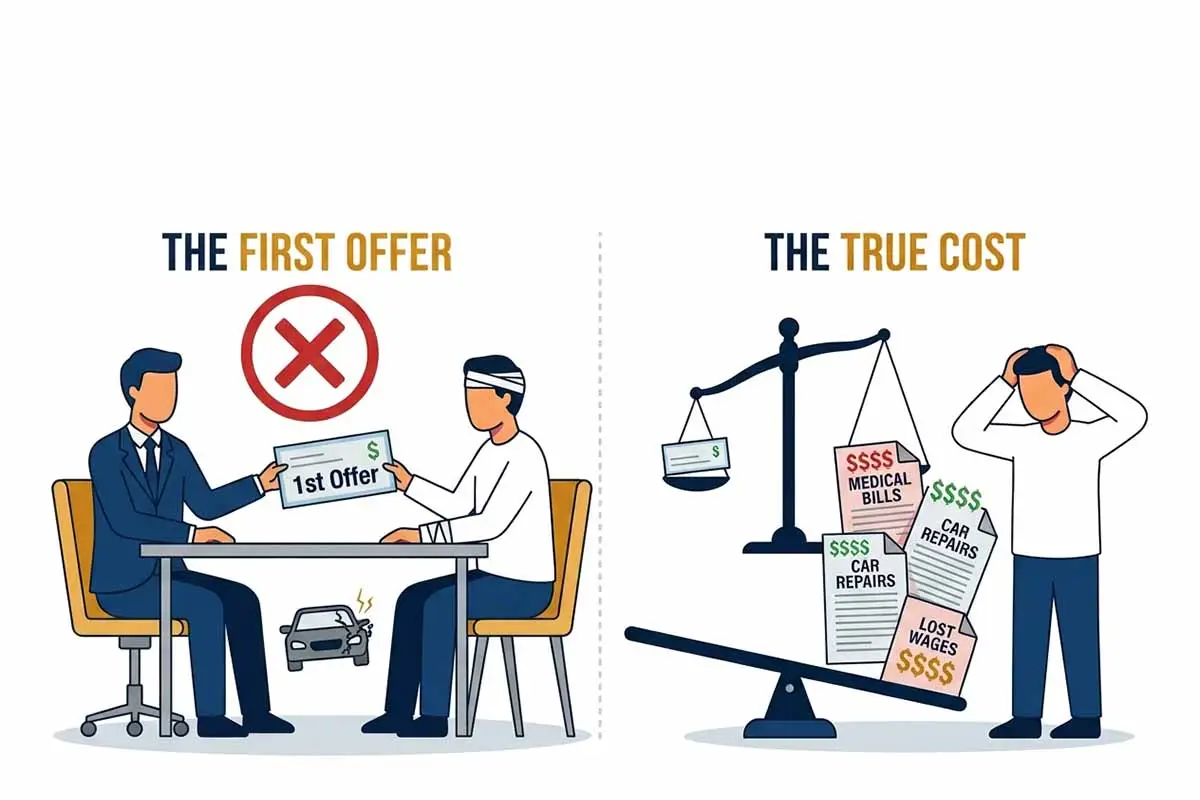
After filing a personal injury claim in California, when the insurance company quickly sends you an offer or first proposal, it's wise not to accept it. It may look like a quick and easy solution from the outside, but behind it lies a specific business strategy of the insurance companies. Below are the main reasons why you shouldn't sign or agree to the first offer:
1. This offer is usually a very low amount
The insurance companies' main goal is to reduce their own costs. They know very well that victims are in financial distress after an accident. Taking advantage of your urgent situation, they offer an amount far lower than the actual damages, hoping you'll agree quickly out of need for money.
2. Future medical costs and income loss get left out
Right after the accident, all of your body's injuries or permanent damage might not be fully apparent yet. Agreeing to and signing the first offer means you're closing that case forever. If it later turns out that you need another 6 months to recover and can't return to work, you won't be able to claim any more money a second time. As a result, your future lost income and the permanent damage to your earning capacity will have to be borne entirely out of your own pocket.
3. They don't calculate bonuses, overtime, and accrued leave
When the insurance company calculates lost wages on their own, they usually take a simple calculation of your basic or base salary. But under California law CACI No. 3903C, you're also entitled to the money for your lost overtime, sales commission, holiday bonus, and the sick leave or vacation time you lost while recovering. In the first offer, insurance companies almost never include these fringe benefits.
4. They avoid the real losses of self-employed people or freelancers
If you're a business owner or freelancer, the insurance company will try to make your lost wages claim seem negligible by pointing to various complexities or expenses in your tax filings. Whereas, with proper financial analysis through a lawyer, your actual loss amount would turn out to be much higher.
Until your doctor declares you 100% recovered or at Maximum Medical Improvement (MMI), don't go for any final settlement. Get the pay stubs, W-2, Schedule C, and Wage Verification letter we mentioned earlier fully prepared beforehand.
Conclusion
"Lost wages" in a California personal injury claim sounds as simple as it seems, but in reality, it's not that simple. It's not limited to just how many days you didn't go to work. It also includes overtime, commission, tips, lost sick leave, fringe benefits, and even the calculation of how much your future earning capacity has decreased.
The biggest mistake people make is rushing to accept the insurance company's first offer. This offer almost always leaves out overtime, bonuses, or future income loss calculations. And once you sign, there's no opportunity to claim anything further.
So the first thing to do after an accident is to organize all documents (medical records, pay stubs, tax files, employer letters) and not go for any final settlement until the doctor declares Maximum Medical Improvement (MMI). If an experienced personal injury lawyer helps you through this entire process, your chances of recovering the compensation you're actually owed increase significantly, something that's often lost when claiming alone.