Uber or Lyft Accident in California — Who Pays and How Do You Claim?
As an Uber passenger if you are hit by a car or you are walking across the street suddenly a rideshare vehicle strikes
you. Now the question arises who is exactly responsible here? Who will get the compensation and how much is it? All
are complicated questions because rideshare accident claims are different from standard car accident claims. Here
claims are changed depending on what the driver was doing at the exact moment of the crash.
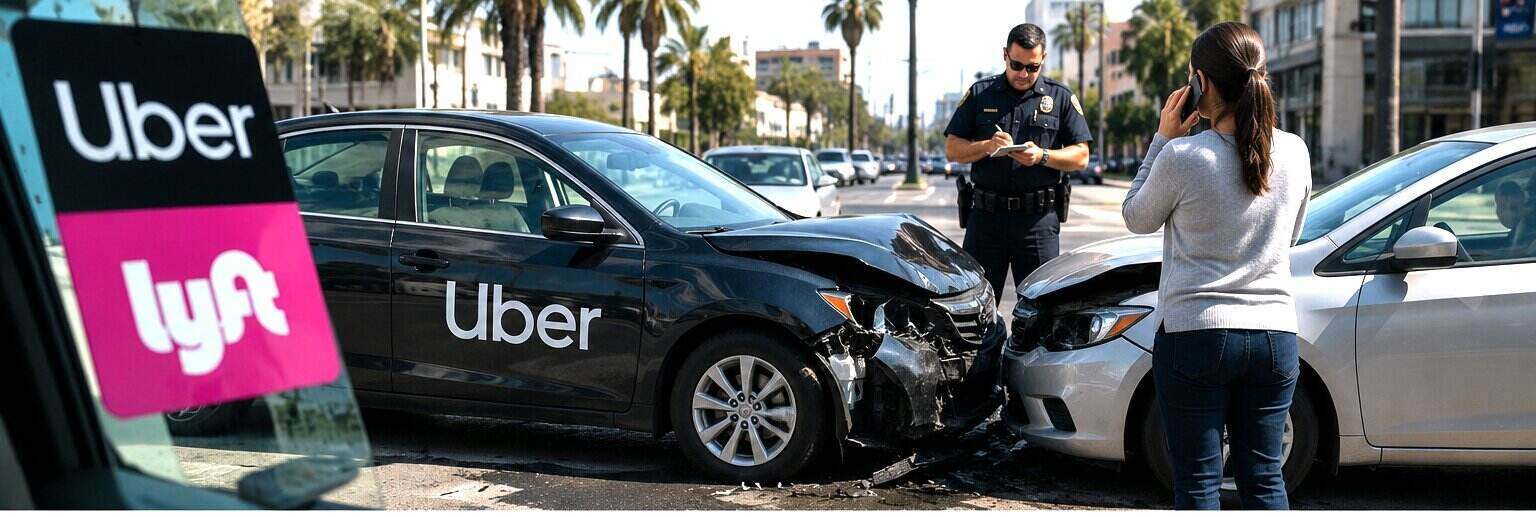
Here we guide you step by step so after reading it you can know who is responsible for paying, how much coverage is
available and how to defend your claims.
THE THREE PHASES OF RIDESHARE INSURANCE IN CALIFORNIA
The most important thing in any uber & lyft accident is understanding the three phases rules. According to those
phases the insurance coverage will change.
Phase 0: If the App is off
If the drivers rideshare app is inactive or off and they are driving their vehicle on their own.
That case is treated like any other personal vehicle accident. Nothing from Uber or Lyft. It comes under drivers
personal auto insurance policy.
Phase 1: If the App is on and the driver is waiting for a ride request
The driver is logged into the app and available for a ride. But he did not get any trip request.
In that case if drivers personal insurance denies the claim Uber/Lyft provide limited coverage.
$50,000 per person for bodily injury
$100,000 per accident for bodily injury
$25,000 for property damage
Phase 2 — If Ride accepted and driver is on the way to pick up the passenger
If the driver accepts a trip request and is on the way to pick up the passenger but has not arrived.
In that case Uber and Lyft's full commercial liability policy is $1,000,000 per occurrence.
Phase 3 — If there is Passenger in the vehicle
If the driver picks up the passenger and the trip is in progress.
In that case the same $1,000,000 commercial liability policy as Phase 2.
Why phase matters so much
You can see the difference between Phase 1 and Phase 2 coverage. The difference is so big, almost $50,000. The
Insurance companies and rideshare companies know this very well so they will dispute which phase applied at the time
of your accident. But an attorney can investigate the app data, GPS records, and trip logs to establish the correct
phase and maximize your available coverage.
UBER’S COMMERCIAL INSURANCE IN CALIFORNIA
Uber Provides commercial insurance for accidents caused by its drivers in California. Here we discuss that.
Phase 2 & 3 during an active trip
$1,000,000 for injuries and damages to passengers, other drivers, pedestrians, and cyclists
If the other driver has no insurance or not enough insurance Uber's policy covers you as a passenger
-
If the uber driver's car is damaged and the driver has collision coverage on their personal policy. Uber will cover it after taking a $2500 deductible which the driver needs to pay first.
Phase 1 while waiting for a ride request
$50,000 per person bodily injury
$100,000 per accident bodily injury
$25,000 property damage
-
This coverage only applies if the driver's personal insurer denies the claim first
Uber classifies drivers as independent contractors
Uber always says their drivers are not their employees, they are independent contractors. So you can’t sue Uber directly. Instead, you can claim against Uber's insurance policy. You can sue Uber directly if you have evidence of Uber hired a bad driver or the app had big design defect
LYFT'S INSURANCE COVERAGE IN CALIFORNIA
Lyft's insurance policies are close to Uber’s policies.
Phase 2 and 3 During an active trip:
$1,000,000 for third party liability coverage
Uninsured or underinsured motorist bodily injury coverage
-
Contingent comprehensive and collision coverage subject to a $2,500 deductible
While waiting for a ride request (Phase 1):
$50,000 per person bodily injury
$100,000 per accident bodily injury
$25,000 property damage
-
Contingent on the driver's personal insurer denying coverage first
Lyft's additional coverage features
Lyft has some cases of additional coverage for passengers injured during active trips. Those coverage will be
available to you depending on the date of your accident and the version of Lyft's insurance program in effect at that
time.
The personal insurance gap
Both Uber and Lyft drivers are required to carry personal auto insurance. But most personal auto policies deny
coverage for commercial activity including driving for a rideshare platform. This means that during Phase 1, if the
driver's personal insurer denies the claim, you fall back on Uber or Lyft's limited contingency coverage. During
Phases 2 and 3, the rideshare company's commercial policy takes over entirely.

WHO CAN FILE A CLAIM?
Not only Uber and Lyft Passenger can just file the claim other drivers, passengers, pedestrians or cyclists can file
the claim too. Multiple types of people can be injured by rideshare drivers and are compatible for compensation.
Rideshare passengers
If you are in an active trip of Uber or Lyft which comes in phase 3 and face an accident you are covered by $1 million
policy no matter which is at fault.
Drivers and passengers of other vehicles
If you are hit by an Uber or Lyft driver, you can file a claim against the rideshare company's insurance.
Pedestrians and cyclists
If you were on foot or on a bicycle and were struck by an Uber or Lyft vehicle, you can also claim.
The Uber or Lyft driver themselves
During an active tip if an Uber or Lyft driver is injured he can claim against the other driver's insurance. Through
Proposition 22's driver benefits program there are some other protection too
Family members of fatally injured victims
If a loved one was killed in a rideshare accident, surviving family members can file a wrongful death claim against
the at-fault parties including the rideshare company's insurance.
HOW FAULT IS DETERMINED IN CALIFORNIA RIDESHARE ACCIDENTS
Finding who is at fault in any rideshare accident is different from normal car accidents. Lets talked about those -
Standard fault investigation
The same evidence applies as in any car accident:
Police report
Traffic camera, dashcam, and surveillance footage
Eyewitness statements
Physical evidence like skid marks, point of impact, vehicle damage
Cell phone records
Rideshare-specific evidence
Rideshare accidents generate unique digital evidence that can be critical to your claim:
GPS logs, timestamps, speed data, route from Uber or Lyft
App activity records like when the app was activated, when the trip was accepted, when the trip ended
The driver's driving record and background check results
In-app communications between the driver and passenger
Those data are sometimes deleted so you need an attorney to request to preserve it.
Potential liable parties in a rideshare accident
Unlike a normal two car accident a rideshare accident involve many potential liable parties
The Uber or Lyft driver for negligent driving
Uber or Lyft for negligent hiring, background checks or platform design issues
If a third-party vehicle caused or contributed to the crash then he
if a defect contributed to the accident then the vehicle manufacturer
If a bad road was a contributing factor then the government
Here always remember liable parties means more available insurance coverage and a higher recovery for you.
THE COMPENSATIONS YOU CAN CLAIM
For the economic damages you will get -
Medical expenses:
Emergency room treatment and ambulance fees
Surgery, hospitalization, and intensive care
Diagnostic imaging — X-rays, MRIs, CT scans
Physical therapy and rehabilitation
Chiropractic care and pain management
Prescription medications
Medical equipment and assistive devices
-
Future medical expenses for ongoing or permanent injuries
Lost income:
Wages lost during recovery
Sick days and PTO used because of the accident
Loss of future earning capacity for permanent or long-term injuries
-
Lost business income for self-employed individuals
Property damage:
Vehicle repair or replacement
Rental car costs
-
Personal property damaged in the crash
The non economic damages you will get
Physical pain and suffering — past, present, and future
Emotional distress and anxiety
Post-traumatic stress disorder
Loss of enjoyment of life
Disfigurement or permanent scarring
-
Loss of consortium
For the rideshare company fault or the driver was reckless, drunk in those cases punitive damages may be available.
Those can increase the total recovery.
HOW MUCH IS YOUR RIDESHARE ACCIDENT CASE WORTH?
Factors that increase your rideshare claim value:
Active trip phase that means Phase 2 or 3 full $1,000,000 policy in play
Severe or permanent injuries
High medical expenses and ongoing treatment
Significant lost wages or career impact
Clear liability Uber or Lyft driver at fault
Egregious driver conduct like DUI, distracted driving, excessive speed
Multiple liable parties identified
Strong digital evidence from app data
-
Young age with long future of pain and limitation
Factors that can reduce your claim value:
Phase 1 at time of crash it limited $50,000/$100,000 coverage
Shared fault on your part
Pre-existing injuries to the same body parts
Gaps in medical treatment
Minor injuries with full recovery
-
Weak or missing evidence
Realistic value ranges:
Minor injuries — soft tissue, mild whiplash, full recovery:
Typical range: $15,000–$60,000
-
Higher floor than standard car accidents due to commercial policy
Moderate injuries — herniated disc, fractures, several months treatment:
Typical range: $75,000–$300,000
-
Commercial policy provides meaningful recovery
Serious injuries — spinal surgery, TBI, permanent disability:
Typical range: $300,000–$1,000,000+
-
Full commercial policy limit potentially in play
Catastrophic injuries — paralysis, severe TBI, permanent total disability:
Typical range: $1,000,000–$5,000,000+
-
Multiple liable parties may need to be pursued beyond the primary policy
Wrongful death:
Typical range: $1,000,000–$10,000,000+
Depends on victim's age, earnings, dependents, and circumstances
STEP BY STEP PROCESS TO FILE A CLAIM FOR CALIFORNIA RIDESHARE ACCIDENTS
In comparison with a normal car accident, filing a rideshare accident claim takes more steps. Here we discuss the steps.
Step 1 — Go for medical attention immediately on the same day. Even if you feel okay. A same day medical visit
establishes a strong connection between the accident and your injuries.
Step 2 — Immediately report the accident through the rideshare app. Both Uber and Lyft have accident reporting
features. Use them to create an official record with the company and preserve your trip data. But do not use the
in-app reporting as your only documentation step.
Step 3 — A police report is official documentation that is very difficult to dispute later. So call 911 and report.
Step 4 — Document everything at the scene, take pictures of both vehicles, your injuries, road conditions, traffic
signals, and the surrounding environment. Also get the rideshare driver's name, license plate, and insurance
information. Screenshot the trip details in the app before closing it.
Step 5 — Collect witness information Names and contact numbers of anyone who saw the accident.
Step 6 — Before contacting Uber or Lyft contact a personal injury attorney first. Rideshare accident claims are
complex, so an attorney will identify all applicable insurance policies, preserve critical digital evidence, and
ensure you do not make statements that damage your claim.
Step 7 — The Attorney will formally notify all parties and also send preservation letters to Uber or Lyft demanding
that all trip data, GPS records, driver history, and app activity be preserved immediately.
Step 8 — Your attorney identifies all applicable insurance policies carefully. The rideshare company's commercial
policy, the driver's personal policy if applicable, and any other potentially liable parties' coverage.
Step 9 — You continue treating until maximum medical improvement. Your attorney coordinates with medical providers on
lien arrangements if needed.
Step 10 — Your attorney sends a comprehensive demand package to all responsible insurers. Negotiation follows. The
vast majority of rideshare accident claims settle without trial.
FREQUENTLY ASKED QUESTIONS
As an Uber passenger that got into an accident what do I do first?
First you should go for medical attention. Secondly, report it in the Uber app. Try to collect driver information,
pictures, incident area pictures. Then contact a personal injury attorney before giving any statement to Uber or any
insurance company.
What if the Uber or Lyft driver was not at fault another driver hit us?
In that case you can file a claim against the at-fault driver's personal auto insurance. If that driver's coverage is
insufficient or they are uninsured, Uber or Lyft's uninsured/underinsured coverage is there for you.
What if the accident happened during Phase 1 when the driver was waiting for a ride?
Your available coverage drops significantly to $50,000/$100,000 from Uber or Lyft — and only if the driver's personal insurer denies coverage first. This makes Phase 1 accidents among the most challenging rideshare claims. An attorney may be able to pursue the driver personally or investigate whether the personal insurer's denial was proper.
Can I sue Uber or Lyft directly?
You can’t directly sue Uber or Lyft, you can only claim against their insurance policy. But you can sue them if you can prove their negligence, like if they hire a driver who has previously bad driving records or if there is a fault in their app.
Does my own auto insurance cover me as a rideshare passenger?
Your own auto insurance MedPay covers if you carry it then it pays your medical bills on the basis of fault and the basis of you are in your own car or someone else's. Your own health insurance is also active to protect you.
What if I was driving my own car and an Uber or Lyft driver hit me?
You can file a third party liability claim against the rideshare driver's personal policy or Uber or Lyft's commercial policy depending on the phase. You can also claim through your own collision and uninsured/underinsured motorist coverage if applicable.
How long does a rideshare accident claim take to resolve?
Minor injury claims may resolve in 3 to 6 months. Moderate injury claims take 6 to18 months. Serious injury cases or those involving litigation can take 1to 3 years.
Will filing a claim affect my Uber or Lyft passenger rating?
No. It does not affect any of your ration as it's your right to claim for an accident.