California Intersection Accidents: Common Causes and Legal Liability
Intersection accidents are one of California's biggest traffic problems, since these locations are where vehicles coming from different directions cross paths. According to the Federal Highway Administration (FHA), about 40 percent of all traffic accidents in the USA occur at various intersections. Accidents at intersections are extremely dangerous, and roughly 20 percent of the state's overall traffic deaths are caused by these intersections. So in today's blog, we will discuss why these accidents happen, how liability is determined under California law, and what you should do if you become a victim of an accident.
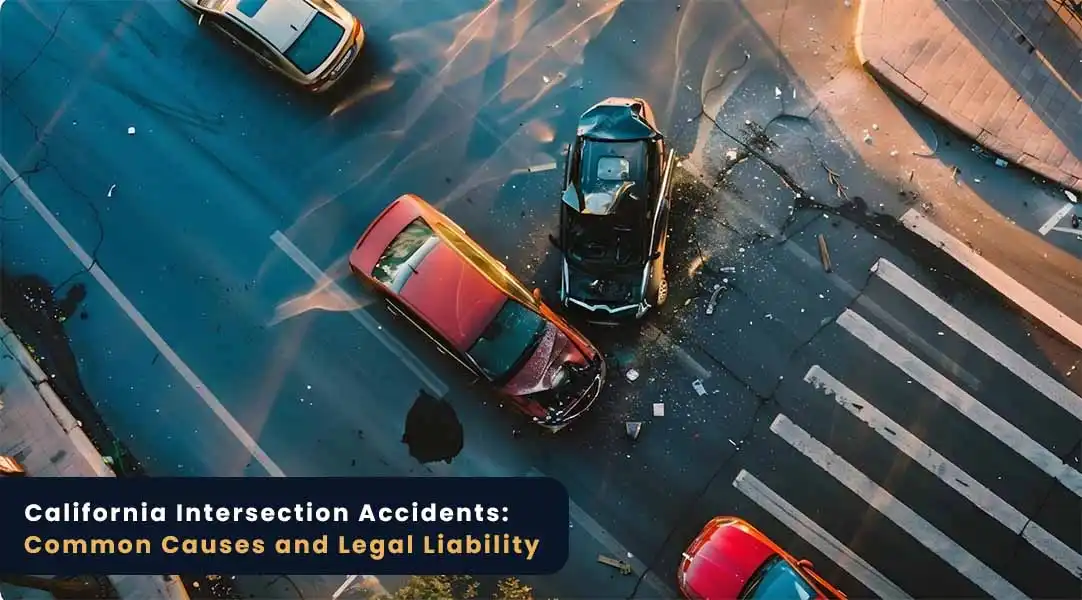
Common Causes of Intersection Accidents in California
The main causes of intersection accidents in California are running red lights, violating traffic rules, excessive speed, and careless driving. Below are the common causes of intersection accidents in California explained in detail:
Running Red Lights and Stop Signs
A study of California's top 50 most dangerous intersections found that running red lights and stop signs was the leading cause of accidents. The tendency to rush through a yellow light causes these accidents, which often result in severe T-bone or head-on collisions.
Failure to Yield Right-of-Way at Intersections
Many accidents happen because drivers misjudge the speed and distance of oncoming vehicles while making an unprotected left turn. This is a well-known problem in California's urban areas. According to California's official traffic data (SWITRS), violations of a vehicle's Right-of-Way are responsible for thousands of injuries at intersections every year. These accidents happen most often when a driver turning left misjudges the speed of an oncoming vehicle going straight.
Unsafe Speeding
Exceeding the speed limit or failing to slow down when approaching an intersection greatly increases the severity of an accident. According to historical data from the California Office of Traffic Safety (OTS), "unsafe speed" is the single largest cause of accidents statewide. Speeding at intersections leaves drivers without enough time to brake, which results in rear-end crashes.
Distracted Driving
A driver's attention shifts away from the road while texting, checking GPS, eating, or talking with a passenger. Even a split second of inattention at an intersection can cause an accident. According to on-scene investigations by the National Highway Traffic Safety Administration (NHTSA), about 38% of intersection accidents happen because of inadequate driver observation or attentiveness.
About 73% of California residents have identified Distracted Driving as their top traffic safety concern.
DUI (Impaired Driving)
Driving under the influence of alcohol or drugs frequently causes intersection accidents in California. Impairment reduces a driver's attention and leads to dangerous behavior such as running red lights and failing to yield to other vehicles, which is a major cause of collisions at intersections and crossings. According to statistics, alcohol impairment is found to be a factor in about 24% of nighttime intersection accidents.
Weather and Road Conditions
Bad weather and poor road conditions frequently cause accidents at California intersections. Accidents sometimes occur because of slippery roads from rain, low visibility from fog, and broken or malfunctioning traffic signals. Often, even light rain causes oil and dirt on the road surface to make it slippery, so when a driver brakes at an intersection, the vehicle can lose control and skid. Likewise, smoke and haze during winter or wildfire season can make it hard to clearly see the intersection or signal ahead.
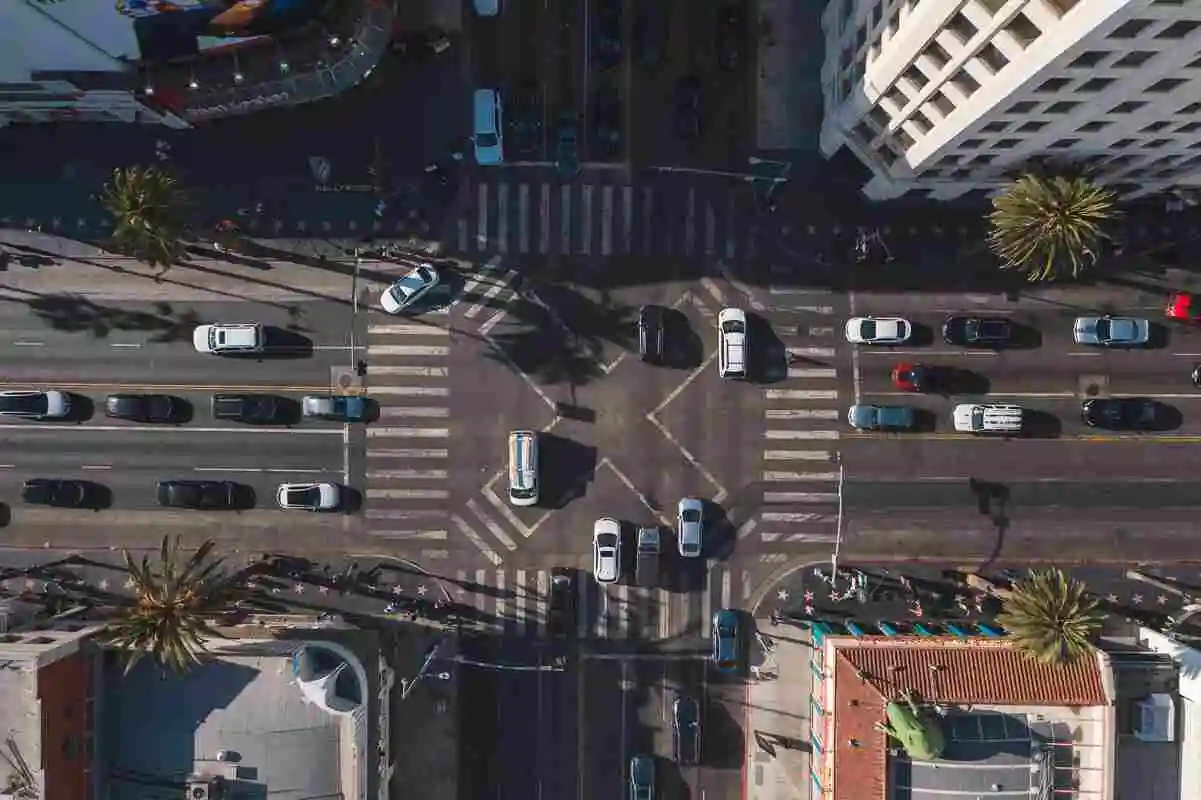
Some of California's Riskiest Intersections
California's riskiest or most dangerous intersections are mainly located in densely populated cities such as Los Angeles, Orange County, and San Jose. According to California Highway Patrol, details of some of the state's riskiest intersections are given below:
Newport Boulevard and 22nd Street/Victoria Street
Newport Boulevard and 22nd Street/Victoria Street is an extremely important, busy, and strategic junction in the city of Costa Mesa in Orange County, California. This intersection is a key transit point for local residents and daily commuters. Because a popular shopping hub is located nearby, there is always heavy vehicle traffic here.
Since it connects arterial routes and the highway, both traffic volume and speed are quite high here. For a long time, there have been safety concerns for pedestrians and cyclists because of fast-moving vehicles on this stretch of Newport Boulevard. The California Department of Transportation (Caltrans) and the Costa Mesa City Council have at various times conducted a Newport Boulevard / State Route 55 Improvement Study to improve traffic management along this corridor and create safer pedestrian crossing facilities.
Edinger Avenue and Ward Street
Edinger Avenue and Ward Street is an extremely important and busy intersection located on the northeastern border of the city of Fountain Valley in Orange County, California. It marks the boundary between Fountain Valley and the neighboring city of Santa Ana.
It is known as one of California's deadliest intersections. According to traffic data, the severity of accidents at this intersection is quite high. Out of all intersections across California, this particular location has recorded the highest number of fatal injuries.
Because it is located next to Mile Square Park and sits at the connection point between Santa Ana and Fountain Valley, there is heavy traffic here every day. Traffic volume increases significantly at this intersection especially on holidays, due to visitors coming to the park. To ensure the safety of pedestrians and cyclists, the Fountain Valley and Santa Ana City Councils have jointly modernized the traffic signals and crossing systems in this area.
Sunset Boulevard and Highland Avenue
Crowded with tourists and local traffic, this intersection is extremely dangerous for pedestrians. Here there is a chaotic mix of crowds of walking tourists, buses, and fast-moving vehicles. Pedestrian accidents occur repeatedly because drivers turning right or left often fail to notice pedestrians in the crosswalk or zebra crossing in time.
A detailed Los Angeles Times report ranked this intersection number one among LA's 14 worst intersections, based on traffic volume and accident rates. Since 2010, more than 312 vehicle collisions have occurred at this single intersection alone.
West Manchester Avenue and South Vermont Avenue
This is one of the highest accident-prone areas in Los Angeles County. This intersection has the highest tendency for high-speed driving and running red lights. As a result, severe T-bone or side-impact collisions occur more often here.
This junction is notorious as one of the top dangerous and high-risk intersections in Los Angeles (LA). The Los Angeles Police Department (LAPD) and various safety surveys (such as MoneyGeek's traffic report) have listed this intersection among the top 5 most unsafe intersections in the entire city.
Sepulveda Boulevard and Roscoe Boulevard
This junction is located on the border of the Panorama City and North Hills areas in Los Angeles's San Fernando Valley. According to Crosstown LA data, this is one of Los Angeles's top risky intersections. Over the past several years, more than 65 serious and fatal vehicle accidents have been recorded here. Drivers frequently get confused due to poor lane-change decisions and the intersection's large, complex layout.
According to recent analysis of traffic and LAPD data, this is one of the most fatal and top accident-prone intersections in all of Los Angeles. A traffic report published by ABC7 in late 2025 showed that more than 65 serious vehicle accidents occurred at this single intersection within just a few years, meaning a severe accident happens here at least once every three weeks.
How Is Legal Liability Determined in California?
California follows a Pure Comparative Negligence policy. This means that in an accident, multiple parties can be partially at fault, and each person's compensation is determined according to their own percentage of fault.
Suppose one driver is found 70% at fault and the other driver 30% at fault. In that case, the second driver can claim 70% of their total damages as compensation, but that amount will be reduced proportionally because of their own 30% share of fault. Notably, in California, even if you are 99% at fault, you can still claim compensation based on the remaining 1%.
Evidence Needed to Prove Liability
To precisely prove legal liability in an intersection accident, California law and insurance companies require specific and irrefutable evidence. Physical evidence plays the key role here, more than verbal claims. Since insurance companies and courts do not issue rulings based on verbal statements alone, the following types of evidence are used to establish legal liability:
- Police Report: The official report prepared by the California Highway Patrol (CHP) or local police after an accident is the first and one of the most important foundations for determining liability. In the report, the investigating officer draws a diagram of the accident and gives an opinion on which driver's error caused the accident. If a driver violates the California Vehicle Code (CVC), the police issue them a ticket or citation on the spot. This is the strongest tool in court for proving Negligence Per Se, or self-evident negligence.
- Video Footage: After an intersection accident in California, video footage serves as extremely neutral and powerful evidence in determining legal liability. It clarifies the state of the traffic signal, proves a driver's error or negligence, and helps apply the principle of comparative fault. Traffic camera or nearby store CCTV footage must be preserved quickly, since this footage is often deleted very fast.
- Witness Statements: Eyewitnesses can clarify who ran the red light at the intersection, or who failed to yield to an oncoming vehicle while turning left. Witnesses can provide precise details about whether there was excessive speed or whether the driver was using a mobile phone.
- Physical Evidence: This mainly includes skid marks or tire marks, the pattern and location of vehicle damage, and debris left on the road, all of which help paint a precise picture of the accident. The location of broken glass and vehicle parts scattered on the road makes clear exactly where within the intersection the two vehicles collided.
- Electronic Data: Data from an Event Data Recorder (EDR), telematics, or CCTV helps neutrally establish a vehicle's speed, braking time, and driver behavior. This data serves as irrefutable evidence to correct or disprove mistaken or biased statements. Under the California Vehicle Code (§9951), specific data protection rules require this information to be collected through the proper legal notice or warrant.
- Expert Opinion: An accident reconstruction expert scientifically and technically explains the speed, angle, and braking distance of the collision, as well as the state of the signal, to help prove who was more at fault or how much negligence existed. Using the principles of physics and engineering, they analyze vehicle speed, skid marks, and impact marks.
What Types of Compensation Can Be Awarded?
Once legal liability is determined after an intersection accident in California, a victim can generally receive three types of compensation, or damages: economic damages, non-economic damages, and punitive damages. Under California's comparative negligence law, you may still be eligible for compensation even if you were partially at fault for the accident.
Economic Damages
Economic damages refer to the direct financial losses caused by the accident that have specific receipts or proof. These include:
- Medical expenses: emergency care, surgery, medication, therapy, and potential future medical costs
- Lost income: wages or salary lost due to being absent from work because of the accident
- Loss of earning capacity: compensation for reduced future income due to long-term physical disability
- Property damage: the cost of repairing or replacing the vehicle, and the value of damaged belongings inside it
Non-Economic Damages
This category covers the mental and physical suffering caused by the accident, which has no direct financial receipt:
- Physical pain and suffering: severe physical pain caused by the accident
- Mental trauma: post-accident trauma (PTSD), depression, anxiety, and insomnia
- Loss of enjoyment of life: being unable to take part in favorite hobbies or normal daily life due to physical disability
- Loss of consortium: being unable to maintain a normal relationship or companionship with a spouse
Punitive Damages
This type of compensation is not awarded in ordinary cases. If it is proven that the at-fault driver acted with extreme recklessness or gross negligence, the court may impose this penalty to punish the driver and to warn others in the future.
Why Is It Important to Consult a Lawyer?
After an intersection accident in California, consulting a lawyer is essential for dealing with legal complexities and the subtle tactics used by insurance companies. Since California follows the "pure comparative negligence" policy, insurance companies try to reduce the amount of compensation by shifting full or partial blame for the accident onto the victim. An experienced lawyer can analyze irrefutable evidence and the relevant sections of traffic law (CVC) to minimize your share of fault as much as possible, ensuring you receive fair compensation.
Among the most important tools in an intersection accident case are video footage, black box data, and eyewitness testimony, all of which can be automatically deleted or lost within 7 to 30 days of the accident. As an ordinary citizen, it is not possible for you to collect this digital evidence yourself. A lawyer immediately sends a spoliation letter to prevent the destruction of evidence, and issues a subpoena through the court to recover hidden evidence. In addition, they protect you from insurance representatives' trap-laden "recorded statements" and properly evaluate all current and future potential medical expenses.
According to Insurance Research Council (IRC) statistics, filing a claim through a lawyer results in an average of 3.5 times more compensation compared to filing on your own.
The biggest advantage is that California personal injury lawyers work on a "contingency fee" basis. This means you do not have to pay any money out of pocket before winning the case and recovering compensation; if the case is lost, no fee applies at all. So, without any financial risk, seeking a lawyer's help within California's specific two-year legal time limit to claim your rights is the wisest course of action.
Conclusion
In conclusion, intersection accidents in California are largely a harsh consequence of drivers' tendency to break the law and to drive carelessly. Since this state follows a fault-based and comparative negligence policy, it is extremely important to quickly gather the correct evidence after an accident in order to avoid legal complications. Conscious and careful driving can greatly reduce this risk. Still, if an accident does happen, knowing about California's comparative negligence law and taking the right steps will help protect your rights. If needed, do not hesitate to seek the help of an experienced lawyer, as it can be an extremely important decision for your physical, mental, and financial well-being.