School Bus Accident Injury Claims in California
For many families in California, the yellow school bus is a part of everyday life. Every day, thousands of children rely on the school bus for transportation to school. School districts, charter schools, and private institutions all depend on this transportation, and there are strict state and federal safety regulations in place.
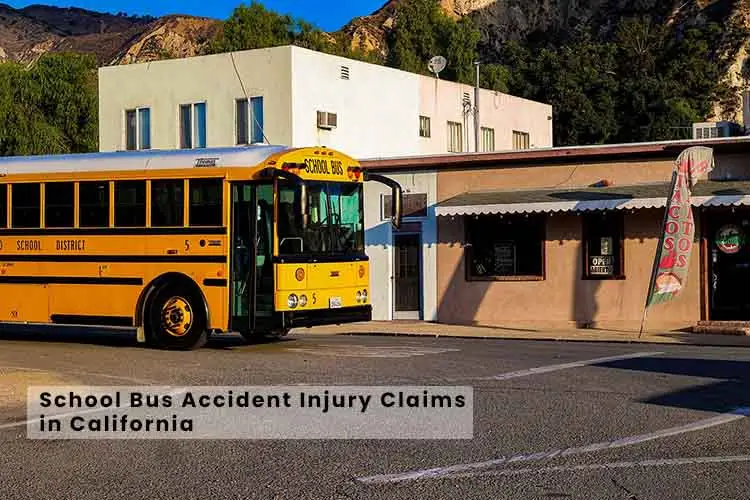
But despite these safety standards, school bus accidents still happen, and when they do, the consequences can be devastating. From collisions with other vehicles to mechanical failures and injuries while boarding or exiting the bus, children can suffer both physical and psychological harm. When an accident occurs, the child's family must deal with the physical injury and emotional stress, and at the same time navigate a complex legal process to obtain compensation.
The rules for claiming compensation for a school bus accident in California are somewhat different from those for a regular road accident, because most school buses are operated under government agencies. So if you don't take the right steps at the right time, it can become difficult to receive fair compensation.
So in today's article, we will try to understand why school bus accidents happen, who is actually responsible for the accident, what to do if your child is injured, and how to claim compensation if injured in a school bus accident in California. Let's begin.
Why Do School Bus Accidents Happen?
According to NHTSA data, a child is about 8 times safer on a school bus than in a family car. The death rate on school buses is only 0.2 per 100 million miles, compared to 1.5 for regular cars.
Even so, it's not that accidents don't happen on school buses. Although California is known for strict traffic laws and rigorous school bus safety regulations, it is identified as the 4th most dangerous state in the U.S. for school bus accidents, and ranks second highest in the number of accidents. The common reasons accidents occur are:
Driver Error & Fatigue
Driver fatigue is a state of physical and mental exhaustion in a driver that severely impairs their ability to drive. If the driver's attention is disrupted by students screaming inside the bus, mobile phone use, or any other reason, an accident can occur. In addition, school bus drivers often have to start their duty very early in the morning. Driving for long hours and lack of adequate sleep create fatigue in drivers, which increases the risk of accidents.
Negligence of Other Drivers
Negligence of other drivers refers to a situation created by another driver's carelessness, irresponsibility, or violation of traffic laws while driving on the road. Under California law, when a school bus stops and its red lights flash, all vehicles behind and approaching from the opposite direction must stop. However, many impatient drivers ignore this rule and try to overtake the bus. Additionally, because of the large size of school buses, they have significant blind spots at the rear and sides. When drivers of smaller vehicles don't understand these blind spots and get too close to the bus, collisions occur.
Mechanical Failures and Lack of Maintenance
A mechanical failure is the unexpected breaking, wearing out, or loss of function of a part or structure, causing it to no longer work properly. If school districts or bus companies fail to perform regular maintenance on buses, serious mechanical failures such as brake failure, tire blowouts, or steering lock-ups can occur.
Weather and Road Conditions
In California's Central Valley and coastal regions, extremely thick fog (Tule fog) forms in winter, reducing visibility to near zero. Meanwhile, in summer, in the Mojave Desert or areas with intense heat, bus tires can overheat and burst, causing accidents.
Risk of Left-Turn Crashes
When a large school bus makes a left turn at a busy California intersection, it occupies a large portion of the road. If a fast-approaching vehicle from the opposite direction cannot judge the bus's speed correctly, a head-on collision can result.
According to statistics, students outside the bus — while boarding or exiting — and pedestrians and occupants of other vehicles are more likely to be harmed in these types of accidents than students who remain inside the bus.
Who Is Responsible for a School Bus Accident?
Determining who is actually responsible for a school bus accident is not always simple, because under California's Pure Comparative Negligence rule, multiple parties can be held responsible at the same time.
Bus Driver
In California, bus drivers are treated as Common Carriers, meaning they must exercise the utmost caution to protect their passengers' safety. If a driver fails to do so by speeding, losing focus due to phone use, ignoring signals, or driving under the influence of alcohol, the driver can be held liable for the school bus accident.
School District / Private Bus Company
Under the principle of Vicarious Liability, the employing school district or private bus company can be held financially and legally responsible for a driver's negligence if they fail to provide the driver with proper training, hire a driver despite a known poor driving record, or fail to perform regular maintenance on the bus.
Other Motorists
If another driver ignores a school bus's flashing red lights or stop sign and attempts to overtake or pass the bus, uses a mobile phone while driving, or disregards traffic signals, that driver may be fully or partially liable for the school bus accident.
According to official California statistics, more than half of school bus accidents occur due to the mistakes of other drivers, such as rear-ending the bus or failing to obey the bus's stop sign.
Bus Manufacturers and Parts Suppliers
Under California Product Liability law, if an accident occurs due to a design or manufacturing defect in the bus, the manufacturer of that bus can be held responsible for the accident.
Government Agencies
In California, a city or county authority can be held responsible for a school bus accident. However, this liability does not depend directly on ownership of the bus, but is instead determined based on the local government's negligence or certain specific factors behind the accident.
If the road is damaged, has a dangerous curve, or if traffic signs or signals are not functioning properly and this causes an accident, the government agency responsible for that road may be held liable.
In complex cases, multiple parties may be found jointly responsible, and compensation may be divided accordingly. For an ordinary person, identifying all the responsible parties is actually the biggest challenge — that is why it is advisable to seek the advice of an experienced attorney in such cases.
What Should You Do If Your Child Is Injured?
If your child is injured in a school bus accident in California, your first and foremost task is to ensure your child receives immediate medical treatment and to take prompt action to protect your legal rights. According to California law, here are the detailed steps you should take in this kind of situation:
Ensure emergency medical care and safety
As soon as the accident occurs, take your child to the nearest hospital or seek help from an emergency medical team. Internal injuries often don't show symptoms right away, so seeing a doctor is essential. Keep all prescriptions, X-rays, and medical reports given by the doctor safely with you.
Gather evidence and information
Write down the date, time, and exact location of the accident, and collect the school bus's license plate number, bus number, and the driver's name and driver's license number. If police arrived at the scene, ask them for a copy of the police report or the report number. If there are any eyewitnesses nearby, try to collect their names and phone numbers.
Notify the school authorities
Inform the school administration or district office about the accident in writing. If the school conducts its own investigation or has an Incident Report, request a copy of it.
Follow the legal steps for claims against government agencies
Filing a lawsuit against a public school bus in California is different, and considerably more complex, than filing for a regular accident, because school districts are generally government entities.
Under California law, to take legal action against a government entity, you must submit a formal written claim (a tort claim) to the school district within 6 months (180 days) of the accident. If you fail to file within this window, you will not be able to file a compensation lawsuit later.
Consult an experienced attorney
Since government law is involved in school bus accidents, it is extremely important to consult with an experienced personal injury attorney. An attorney can help you obtain the correct amount of compensation for your child's medical expenses, emotional trauma, and future medical costs.
Conclusion
A school bus accident is a difficult experience for any family. In that moment, the child's well-being comes first, but delaying legal matters can lead to regret later.
In California, you only have 6 months to file a compensation claim against a public school district. Once this deadline passes, nothing more can be done.
So, seek medical treatment immediately after the accident, gather evidence, and speak with an experienced personal injury attorney. Only by taking the right steps at the right time will your family have the opportunity to receive fair compensation.